
A Homebuilder’s Expert Guide to Building a New Home
Over the span of more than two decades building homes across Central Virginia and North Carolina, our team of land developers, planners, builders, and designers has answered a lot of questions. Most of them come from home buyers doing the right thing — trying to understand a complex process before they commit. Their challenge: they can’t find straight answers anywhere.
“Every buyer who walks through our door has questions. That’s not a problem — that’s the start of a good build. The ones who ask questions early make better decisions, and better decisions make for smoother projects.”
— Corey Morrissette, Owner, Rock River Homes

Most builder websites are built to impress, not to inform. Our goal is for you to come to that first conversation with a solid understanding of how the process works, so you can ask better questions and make confident decisions from the very beginning. To make that a little easier, we’ve put together a list of the questions we hear most—grouped by where buyers are in the process—and answered them the same way we would if we were sitting across the table from you.
If you want the quick version, our FAQ page covers the basics. This goes deeper.
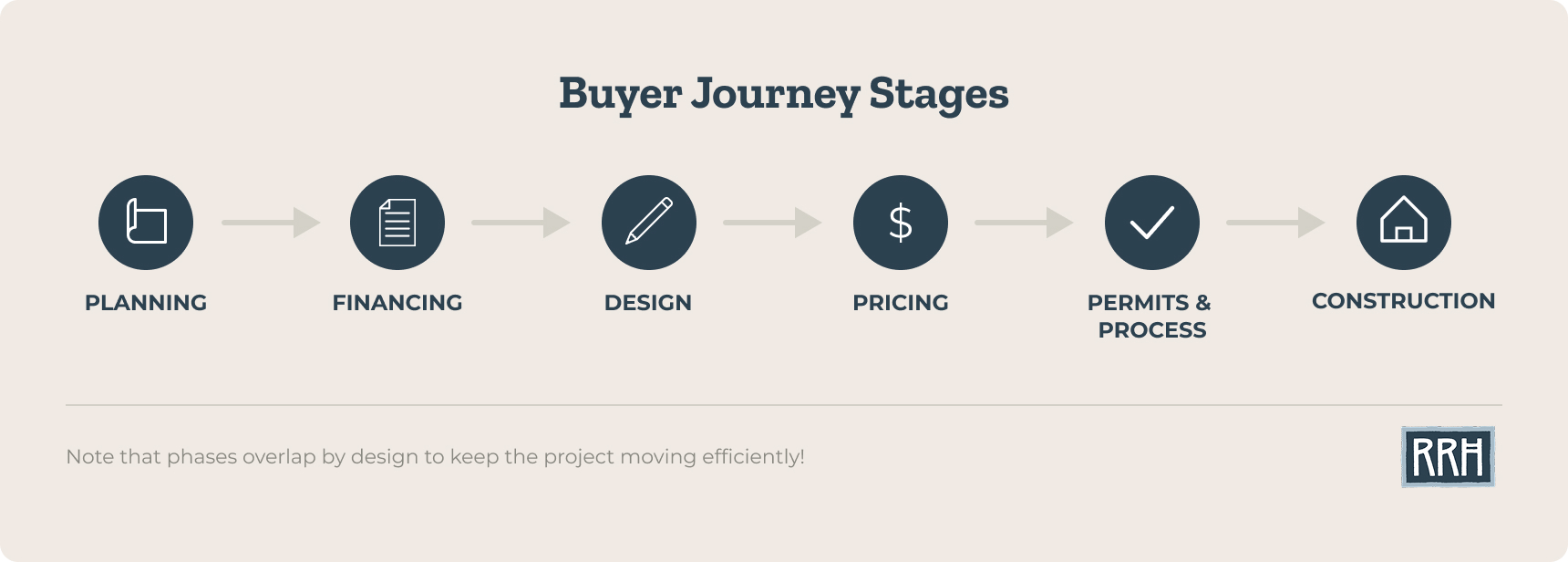
Buyer Stage 1: Planning
Most future homeowners arrive with land questions before they’ve even thought about a floor plan. These are the foundational questions — what’s possible, what’s required, and what the full picture actually costs — before anything else gets decided.
Can I build on any piece of land in Virginia?
Short answer: no. Not every piece of land is buildable, and finding that out after you’ve made an offer is an expensive lesson.
Zoning is the first filter — the land has to be zoned for residential use. After that, flood zone designation matters. Land in a FEMA-designated flood zone can still be built on in many cases, but it adds cost and complication. Wetlands are a harder stop. Federal regulations restrict development on wetland parcels significantly. Minimum lot size requirements vary by county, and setbacks (the required distance between the house and the property line) affect how much usable building area you actually have.
But the single most important step before purchasing rural land in Virginia is getting a perc test done. That test tells you whether the soil can support a septic system. No perc, no septic approval. No septic approval, no building permit. We’ve seen first-time builders skip this step and pay for it. Don’t be that person!
“We tell every buyer the same thing: talk to a builder before you buy the land, not after. A 30-minute conversation can save you from making a very expensive mistake.”
— Becky Hensley, Land Acquisition, Rock River Homes

Pro Tip: Start With the Land
The most expensive mistakes in new home construction happen before the first shovel hits the ground — usually because the land was purchased before talking to a builder. A quick conversation early can tell you whether a parcel is worth pursuing, what site prep will cost, and whether the lot can support the home you’re picturing. It costs you nothing and can save you a lot.
How much land do I need to build a house?
There’s no universal minimum in Virginia, it varies by county, by zoning district, and by what systems you’re installing. The lot size question and the septic question are tied together more than most property buyers realize.
A conventional septic system needs a certain amount of suitable soil area to function properly. Smaller lots in some counties may not have enough room to meet both the house setbacks and the septic drain field requirements. The only way to know for sure is a site visit with a builder and a soil evaluation.
If you’re looking at a parcel under two acres in a rural county, reach out before you make an offer. We can give you a quick read on whether it’s worth pursuing.
What are the real costs beyond the house price?
This is the question that catches the most home and land buyers off guard. The price of the home itself is one line item. The total project budget has several more, and the gap between the two can be significant depending on the condition of your land.
Here’s what the full budget typically includes:
- Land cost (if purchasing)
- Base home price
- Floor plan modifications and upgrades
- Site prep: clearing, grading, driveway installation
- Well drilling (if no public water available)
- Septic system installation
- Electrical hookup or underground service
- Permit fees, which vary by county
- Construction loan closing costs and interest during the build
We’ve published a full breakdown in our Hidden Costs of Buying Land in Virginia post that goes into real cost ranges for each category. If you’re trying to build a realistic budget, start there.

Buyer Stage 2: Financing
Financing a new build on rural land is different from a traditional home purchase — and homebuyers in Virginia’s rural counties have more options than most of them realize. This is also where we see the most confusion, so we’ll keep it as simple as possible.
Can I use land I already own as a down payment?
Yes — and this is one of the most overlooked facts in rural new construction financing. If you already own land, whether you purchased it or inherited it from family, the equity in that land typically counts as your down payment on a construction loan.
For a lot of home seekers in Central Virginia, this changes everything. They’ve been sitting on five acres of family land in Amelia or Nottoway for years, paying taxes on it, assuming they’d need to save up a cash down payment to build. In many cases, that land is the down payment. A lender experienced in rural construction financing can walk you through exactly how it works for your situation.
“Family land is the down payment for more of our buyers than you’d think. It’s one of those things nobody tells you until you ask the right person.”
— Becky Hensley, Land Acquisition, Rock River Homes
What loans are available for building in rural Virginia?
There are three main paths most of our new construction buyers use, and which one fits depends on your income, your land situation, and your service history.
- Construction-to-permanent loans fund the build in draws — meaning the lender releases money in stages as construction milestones are hit — then convert to a standard mortgage when the home is complete. This is the most common path for buyers who don’t qualify for USDA or VA loans.
- USDA Rural Development loans offer zero-down financing for buyers in eligible rural areas. Most of Rock River’s 48-county service area falls within USDA-eligible zones, and most qualifying buyers have no idea this option exists. If you’re buying or building in a rural Virginia county, it’s worth a conversation with a lender before you assume you need a down payment.
- VA loans are available to eligible veterans and can be used for new construction in many cases. If you’ve served, this should be one of the first conversations you have with a lender.
We work closely with Alcova Mortgage, who has real experience with rural Virginia construction loans — not just conventional purchases. That distinction matters more than most buyers realize. We’re happy to make that introduction. You can also read more in our Construction Loans Explained post.
Builder's Dictionary for the Layperson
- Draw Schedule — The timeline of payments your lender releases to your builder during construction. Instead of handing over the full loan amount upfront, the lender releases funds in stages — called draws — as each phase of the build is completed and inspected.
- Construction-to-Permanent Loan — A loan that covers the cost of building your home and then automatically converts to a standard mortgage once construction is complete. One closing instead of two, which saves time and closing costs.
- Certificate of Occupancy (CO) — The official document issued by the county confirming your home meets all local building codes and is safe to live in. You can’t legally move in without it. It’s the finish line.
- Setback — The minimum required distance between your home and your property line. Every county has them, and they affect how much usable building area you actually have on a given parcel.
What credit score or income do I need to qualify for a construction loan?
We’re builders, not lenders, so we’re going to be careful here — qualification requirements vary by loan type, lender, and your specific financial picture, and the right answer for you comes from a direct conversation with someone who does this for a living.
What we can tell you is that construction loans generally have stricter qualification standards than conventional purchase mortgages, and not every lender handles them the same. Working with a lender who has real experience in rural new construction — not someone who mostly does refinances — makes a meaningful difference in how smoothly that process goes.
If you’re not sure where to start, reach out to us first. We’ll connect you with the right people and give you an honest read on whether now is the right time to build or whether you’d benefit from a few more months of preparation.
Pro Tip: Talk to a Lender Early
Start your financing conversation before you finalize a floor plan — not after. Buyers who know their budget and loan type before they sit down with us move through the process faster and with fewer surprises. We can help point you in the right direction.
Buyer Stage 3: Design
One of the most common misconceptions buyers arrive with is that they need to hire an architect or show up with blueprints in hand. This section clears that up and explains how the design process works when you’re building with a semi-custom builder.
Do I need an architect to build a house?
When you build with a semi-custom builder, like Rock River Homes, the plans are already done — you’re choosing from a library of proven floor plans, not starting from a blank sheet of paper. That saves time, saves money, and removes a lot of uncertainty from the process.
Full custom builds — where a buyer wants a completely original design with no existing plan as a starting point — typically require an architect, which adds cost and time. If you’re drawn to something custom, it’s worth seeing our floor plans first. Many first time buyers find the level of modification available covers what they had in mind, without the added time or cost.
Pro Tip: See the Plans Before You Decide
Most buyers who think they want a fully custom home haven’t actually seen what semi-custom can do. Before you budget for an architect, spend 30 minutes with our floor plans and a list of the changes you’d want to make. In most cases, what you’re picturing is already achievable — and at a fraction of the cost and timeline of starting from scratch.
What is the difference between custom, semi-custom, and spec homes?
These three terms get used loosely in the industry, so here’s what they actually mean:
- Full custom: You start with a blank sheet and work with an architect to design an original home. Maximum flexibility, highest cost, longest timeline, and the most decisions to make. This is typically for households with significant budgets and very specific visions.
- Semi-custom: You start with an existing floor plan and modify it. Rock River is a semi-custom builder. You get real personalization — wall changes, room additions, finish selections — with predictable pricing and a proven starting point.
- Spec homes: Homes that are already built or near completion, ready for move-in. Rock River builds select spec homes on our own lots. If waiting isn’t in the cards, a spec home gives you new construction quality with a much shorter timeline.
Rock River operates across two of these categories — primarily semi-custom builds — with spec homes available for home seekers who want to move faster.
Can I build a completely custom home with Rock River Homes?
Rock River is a semi-custom builder. That means you’re not getting a cookie-cutter subdivision home — but also, you’re not starting from scratch with an architect.
We have 18+ floor plans, all named after Virginia rivers and creeks — the Nottoway, Cedar Creek, Rappahannock, Rivanna, and others. Every one of them is a starting point, not a finished product. Buyers regularly move walls, expand garages, add mudrooms, build in sunrooms, reconfigure bedroom layouts — the plans are designed to flex.
For most buyers, that’s a relief. You get real personalization without the blank-sheet uncertainty, and the pricing stays predictable because we’ve built these plans before.
“People hear ‘semi-custom’ and think they’re getting less. What they’re actually getting is a plan that’s already been thought through — and the freedom to make it theirs without reinventing the wheel.”
— Rachel Valenza, Design, Rock River Homes
Buyer Stage 4: Pricing
Pricing transparency is one of the areas where builders vary most — and where new construction buyers are most often burned. Here’s how Rock River approaches it, and what you should expect to understand before signing anything with any builder.
How much does it cost to build a home?
Rock River pricing starts in the mid-$200s for a standard build on a prepared lot. We’ll give you a ballpark number on the first phone call — no waiting, no runaround, no ‘someone’ll get back to you after a site visit.’ You deserve to know if we’re in the same universe before you invest more time.
The more important number is the total project budget, which includes land, the base home, any modifications, site prep, well and septic if needed, and financing costs. Those additional line items vary significantly by property, which is why two buyers building the same floor plan can end up with meaningfully different total costs.
Our Hidden Costs of Buying Land in Virginia post has real cost ranges for each category. Check it out before you build a budget.
What is included in a home’s contract price?
Before we sign anything, you’ll select every finish in the home — flooring, cabinets, countertops, fixtures, doorknobs, all of it. Those selections go into the contract. The contract price is the final price. We don’t do surprise change orders after signing.
What that means in practice: there’s more work upfront to nail down your selections, but you go into construction knowing exactly what you’re getting and what you’re paying. No ‘allowance’ language that leaves room for sticker shock later.
“We’ve heard too many stories from buyers who signed a contract with an allowance for cabinets, then found out the allowance covered laminate when they wanted wood. We don’t do it that way. You pick it before you sign it.”
— Jerry Throckmorton, Project Manager, Rock River Homes

Can I make changes after the contract is signed?
Yes — and we want to be clear about that, because some future homeowners worry they’re locked into something the moment they sign. You’re not. Life happens, priorities shift, and sometimes you see something during the build that makes you want to do things differently. We get it, and we work with you when it comes up.
What changes after signing is the process. Any modification to the scope, materials, or design after the contract is executed becomes a change order — a written amendment that documents what’s changing, what it costs, and how it affects the timeline. We put it in writing so both sides are protected and there are no surprises.
Changes made early in the process are almost always easier and less expensive than changes made later. Moving a wall during framing is a different conversation than moving it after drywall is up. And any change that affects materials or subcontractor scheduling can ripple into the timeline — sometimes by days, sometimes longer depending on the scope. None of that means don’t do it. It means come to us as soon as you’re thinking about it, and we’ll give you an honest picture of what it involves before you decide.
What typically causes a build to go over budget?
Most budget overruns trace back to one of three things:
- Selections upgrades after signing: If you lock in a contract with standard finishes and then upgrade mid-build, that’s a change order — and change orders can cost more than decisions made upfront. Rock River’s process attempts to avoid this by finalizing selections before the contract is signed.
- Unexpected site conditions: Hidden rock, high water tables, or soil conditions that require a more complex septic system can add cost that wasn’t in the original estimate. A thorough site evaluation before signing — including a perc test — reduces this risk significantly.
- Scope additions: Adding a garage bay, expanding a room, or adding a structure after the contract is signed always costs more than planning for it from the start. If you’re thinking about it, say so early.
Buyer Stage 5: Permits and Process
Permitting requirements vary significantly across Virginia counties — what’s required in Amelia isn’t necessarily the same as what’s required in Louisa or Buckingham. This is one of the areas where a builder with experience across multiple counties makes a real practical difference.
What approvals are required before building in Virginia?
At minimum, you’ll need:
- A building permit from the county — this requires approved plans, and the timeline varies by jurisdiction
- Health department approval for your septic system — this follows from the perc test
- Zoning compliance confirmation — the parcel has to be zoned for the intended use
- An erosion and sediment control plan — required in most Virginia counties for any land disturbance
Some counties have additional requirements or longer review timelines than others. Rock River has built homes across approximately 48 Virginia counties, which means our permit applications go in complete and correct the first time. Resubmissions add weeks — sometimes months — to a project. Builder experience across your specific county matters more than most prospective homeowners realize.
What happens if my land fails the perc test?
It doesn’t automatically mean the land is unbuildable — but it does mean a conventional septic system won’t work there.
When a conventional perc fails, the next step is evaluating whether an alternative or engineered septic system can meet the site conditions. These systems — mound systems, drip irrigation systems, and others — can work on more challenging soils, but they cost more to install and sometimes more to maintain. In some cases, a soil scientist or engineer can identify suitable areas on the parcel that a standard perc test missed.
In some cases, the land genuinely can’t support any system. That’s a hard stop. Which is exactly why we say: perc before you purchase. A failed perc after closing is a much bigger problem than a failed perc before.
“Site conditions can surprise you — that’s just the reality of building on rural land. A thorough evaluation upfront is always cheaper than discovering a problem after the contract is signed.”
— Travis Morrissette, Foundation & Site Prep, Rock River Homes
How do I afford the down payment?
Two options that most rural homeowners in Virginia don’t know about:
- Land as equity: If you already own land — purchased or inherited — that equity typically counts as your down payment on a construction loan. This applies to family land that’s been in your name for years, not just recently purchased parcels. We covered this in the Financing section above, but it bears repeating: for a lot of buyers, the down payment is already sitting on the ground.
- USDA zero-down loans: Most of Rock River’s service area falls within USDA Rural Development eligible zones, which means qualified buyers may be able to build with no down payment at all. Income limits apply, but many working families in Central Virginia fall within those limits and don’t know it.
Rock River can help connect you with lenders who specialize in these options. Don’t assume you need 20% in cash before you start the conversation.
Where does Rock River Homes build?
Rock River builds across approximately 50 Virginia counties, with a primary focus on Central Virginia — Amelia, Nottoway, Powhatan, Goochland, Louisa, Fluvanna, Buckingham, Cumberland, and surrounding counties — plus the Northern Neck and the Lake Gaston area along the Virginia/North Carolina border.
If you’re not sure whether your county is in our service area, the easiest thing to do is call. The answer is usually yes.
Buyer Stage 6: Construction
Buyers often underestimate how many steps happen before the first wall goes up — and how much influence their own decisions have on the pace of the build. This section aims to set realistic expectations for us all to follow.
How long does it take to build a new home?
From the day you first call us to a signed contract is typically around 60-90 days — selections, financing, plan modifications, and paperwork take time to do right. From a signed contract to move-in on a prepared lot runs six months or more. Raw land that needs clearing, site work, and utility installation adds time on the front end.
The full picture — from first conversation to keys in hand — is typically 8 to 12 months for most Rock River builds. That range reflects real variables: how quickly permits move in your county, how decisive you are on selections, and how much site work your land needs.
We go deeper on the full phase-by-phase timeline in our How Long Does It Take to Build a Home post.

What are the major steps in building a home?
Every Rock River build moves through the same sequence, even if the timing varies:
- Site prep and foundation — clearing, grading, footings, foundation pour
- Framing — wall framing, roof trusses, sheathing
- Mechanical rough-ins — plumbing, electrical, HVAC, with county inspections at each
- Insulation and drywall — insulation inspection, then hang, tape, mud, sand, prime
- Interior and exterior finishes — paint, trim, cabinets, flooring, siding, roofing
- Punch list and Certificate of Occupancy — final walkthrough, corrections, CO inspection, keys
Phases overlap by design — framing can begin while mechanical planning is underway, for example. The goal is to keep the sequence moving without skipping inspection checkpoints.
What decisions do I need to make before construction starts?
More than most home seekers expect. By the time we break ground, the following should already be locked in:
- Floor plan selected and modifications finalized
- All interior selections made: flooring, cabinets, countertops, fixtures, hardware
- Construction financing approved and in place
- Perc test completed and septic system type confirmed
- Survey on file
- Permit applications submitted (we handle this, but it requires your selections and plans)
Buyers who come to the table with the land-side items already done — perc test complete, survey on file, lot cleared — consistently have the smoothest builds. The more you can resolve before we sign a contract, the fewer variables there are once construction starts.
“The buyers who move through construction the fastest are almost always the ones who came in the most prepared. It’s not luck — it’s front-loading the decisions that would otherwise slow you down mid-build.”
— Jerry Throckmorton, Project Manager, Rock River Homes
Pro Tip: Front-Load Your Decisions
The decisions you make before construction starts are cheaper and faster than the ones you make during it. Every change after signing a contract is a change order. Every selection you haven’t made is a potential delay waiting to happen. The buyers who move fastest are the ones who show up prepared.
Learning More About Building a Home in Virginia
New home construction and land buying involve a lot of terminology that’s unfamiliar at first — perc tests, draw schedules, construction-to-permanent loans, easements, setbacks. Understanding what these terms mean helps buyers ask better questions and make more confident decisions.
Rock River maintains a glossary of common construction and land-buying terms on our website — it’s a useful reference if you’re early in the process and building your vocabulary.
Bringing It All Together
Building a home in Central Virginia involves a lot of moving parts — land, cost, design, financing, permits, and timing all affect each other, and a decision made in one area ripples into the others. Most of the uncertainty buyers feel at the start of this process comes from not having clear answers early enough.
The questions in this post are the ones we’ve answered hundreds of times across more than two decades of builds in Central Virginia. They’re common because the process is genuinely complex. Not because buyers aren’t smart enough to figure it out, but because most builders don’t make it easy to get straight answers before you’re already committed.
The best move, at any stage of this process, is to start talking to a builder early — before you purchase land, before you apply for financing, before you’ve made commitments you can’t undo. The earlier we can have a conversation, the more options you have.
Ready to Ask Your Questions?
If you’ve read this far and still have questions, that’s normal. The next step is a conversation, not a commitment. We’ll give you honest answers about your specific situation, including whether we’re the right fit for what you’re trying to build.
Call us at (804) 561-0262 or reach out through our contact page.

Become Part of the RRH Family
Explore the ways Rock River can help you find the perfect fit for you and your family.