
How Long Does It Take to Build a Home? A Month-by-Month Look
One of the first questions people ask when planning a new home is: How long will it take to build?
For a new construction home in rural Central Virginia, the typical timeline runs 6 to 12 months from contract to move-in, depending on whether your land is already build-ready, how quickly permits move in your county, and how decisive you are when it comes to picking colors and fixtures.
If waiting isn’t in the cards, Rock River Homes offers spec homes that are move-in ready — which can significantly reduce the wait compared to a ground-up build. But if you’re planning a custom or semi-custom build, here’s a realistic, phase-by-phase look at what happens between the day you sign and the day you get your keys.

| Weeks | Phase | Key Tasks |
|---|---|---|
| 1–6 | Phase 1: Pre-Construction | Finalize plans, secure financing, permitting, PERC, survey |
| 5-10 | Phase 2: Site Prep & Foundation | Clearing, grading, footings, foundation pour & inspection |
| 10–14 | Phase 3: Framing | Wall framing, roof trusses, sheathing |
| 12–16 | Phase 4: Mechanical Rough-Ins | HVAC, plumbing, electrical; county inspections |
| 14–20 | Phase 5: Insulation, Drywall & Finishes | Drywall, paint, trim, cabinets, flooring |
| 18–24 | Phase 6: Final Trades & Punch List | Fixtures, CO inspection, final grading & seeding |
A General Note on Timing
While there’s an order and process to building your home, there is some overlap in each of the stages. Framing might wrap up while mechanical planning is already underway, for example. We sequence the work to keep things moving efficiently without skipping steps or cutting corners on inspections.
Phase 1 — Pre-Construction (Weeks 1–6)
A lot happens before a shovel ever hits the ground. Pre-construction is where your semi-custom home build takes shape on paper — and where delays are easiest to prevent.
During this phase, you’ll work with partners to:
- Nail down your floor plan and selections
- Finalize construction loan approval
- Apply for permitting, which varies by county — Amelia, Louisa, and Fluvanna each run on their own schedules, and some counties move slower than others.
- Get a soil evaluation or PERC test to assess the property’s ability to absorb and filter water waste
- Survey the property to understand property lines and easements
One of the best ways to keep your project moving is to start financing conversations early. Buyers who have financing in place before signing a build contract are often able to move through the pre-construction phase more efficiently. For tips on getting started, check out this post on navigating construction loans.
Phase 2 — Site Prep and Foundation (Weeks 5–10)
This is where the lot starts looking like your future home.
- Land is cleared, graded, and rough-in work begins on the driveway.
- Footings are dug and poured, the foundation goes in, and county inspectors sign off before anything moves forward.
“The clearing and foundation phases are the most critical times that weather can affect timeframes. Wet and cold weather really affect our ability to clear trees, move soil, and pour concrete” says Corey Morrissette, owner of Rock River Homes.
Site preparation is one of the most weather-dependent phases of the process. In Central Virginia, winter temperatures and spring rain can affect excavation, concrete work, and site access, which is why experienced builders plan schedules around seasonal conditions whenever possible.
If you’re starting a build in late fall, your site prep phase may run longer than it would in spring or summer.
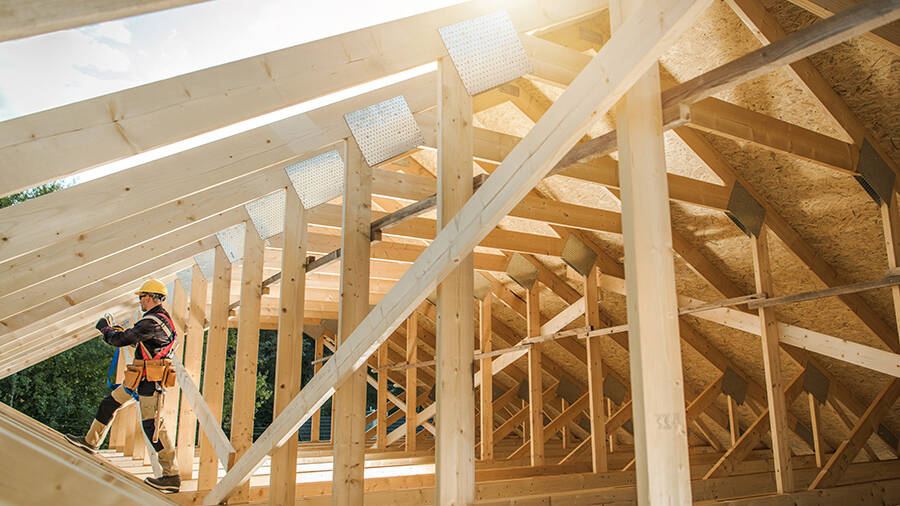
Phase 3 — Framing (Weeks 10–14)
Framing is the phase buyers get most excited about. While it’s exciting, there are also a lot of technical terms getting thrown around. We’ve highlighted a few below to help you navigate this process with ease!
Builder’s Dictionary for the Layperson
- Footings: The concrete base below your foundation walls that spreads the weight of your home across the ground. They’re like the feet of your house keeping your house from sinking, and they’re dug below the frost line so that winter doesn’t disturb them.
- Roof Truss: The pre-built triangle frame that holds your roof up. Instead of cutting and assembling on-site like, trusses are engineered and built in a factory, delivered, and lifted into place.
- Rough-In: This is where your plumber, electrician and HVAC crew run the pipes, wire and ductwork through the walls and floors, before they get covered up with drywall and flooring materials.
- Sheathing: Panels that get nailed to the outside wall framing and roof trusses before anything goes on—it’s like a skeleton getting skin.
Framing often moves quickly, but weather can temporarily slow progress. Heavy rain, high winds, or extreme temperatures may affect the schedule, particularly on rural homesites with limited shelter. Because Rock River works with established local trade partners throughout Central Virginia and into North Carolina, crews are familiar with local conditions, permitting requirements, and construction practices. If all goes well, in a matter of days you go from a flat slab to walls, roof trusses, and sheathing!
This phase is usually the most dramatic visual transformation in the entire build — and the phase where buyers most often want to stop by the lot for a look. If you want to stop by and check on progress — and most buyers do — just give us a heads up before you come out. The site is an active work zone, and a quick call means we can make sure the right people know you’re coming and you can see everything safely.
Phase 4 — Mechanical Rough-Ins (Weeks 12–16)
This is where the systems that make your home run – HVAC, plumbing, and electrical – are installed. It’s a critical, and sometimes time-consuming stage, with each system requiring its own county inspection before work can advance. You can expect inspector scheduling in rural Virginia counties to add a few days at each checkpoint, so be prepared.
This is a point where delays tend to compound if a builder isn’t proactive. Rock River Homes coordinates inspection scheduling in advance, which helps keep the sequence moving efficiently. Subcontractor availability in rural markets can be tight, so Rock River’s established local relationships mean the mechanical crews are already lined up, not waiting on a callback.
Mechanical FAQs
- What do inspectors check during the HVAC rough-in? They want to make sure the ductwork is the right size for the house, that everything is hung and supported correctly, and that the heating and cooling system is safe, before the drywall goes up.
- What do inspectors check during the plumbing rough-in? They're making sure pipes are the right size, running the right direction, and not leaking under pressure. They also check that the venting is in place — without that, you'd end up with sewer gas coming back up through your drains, which nobody wants.
- What do inspectors check during the electrical rough-in? They're looking at how the wiring is run, whether the circuits are sized correctly, and that nothing is set up in a way that could start a fire or shock somebody once the walls are closed.
Phase 5 — Insulation, Drywall, and Interior Finishes (Weeks 14–20)
This is the phase where the house starts looking like your home. Paint colors, cabinetry, flooring, and trim are installed, and the finished spaces begin to take shape.
- Insulation is added and inspected.
- Drywall is hung, taped, mudded, sanded and primed.
- Trim follows after, and then you’re ready for paint.
- Cabinets and flooring are fitted and installed.
Selection delays are one of the most common causes of schedule extensions during the finish phase. Finalizing decisions early helps materials arrive on time and allows crews to stay on schedule. Rock River walks buyers through the selections process early on, so when the crews are ready to finish, you’re ready too.
Pro Tip: Lock In Your Selections Early
Undecided selections are one of the most common causes of timeline delays in the finish phase. Rock River works with buyers to finalize material choices well before the home is under construction — not after. If you’re still deciding on cabinets at Week 4, expect the schedule to flex.
Phase 6 — Final Trades and Punch List (Weeks 20–24)
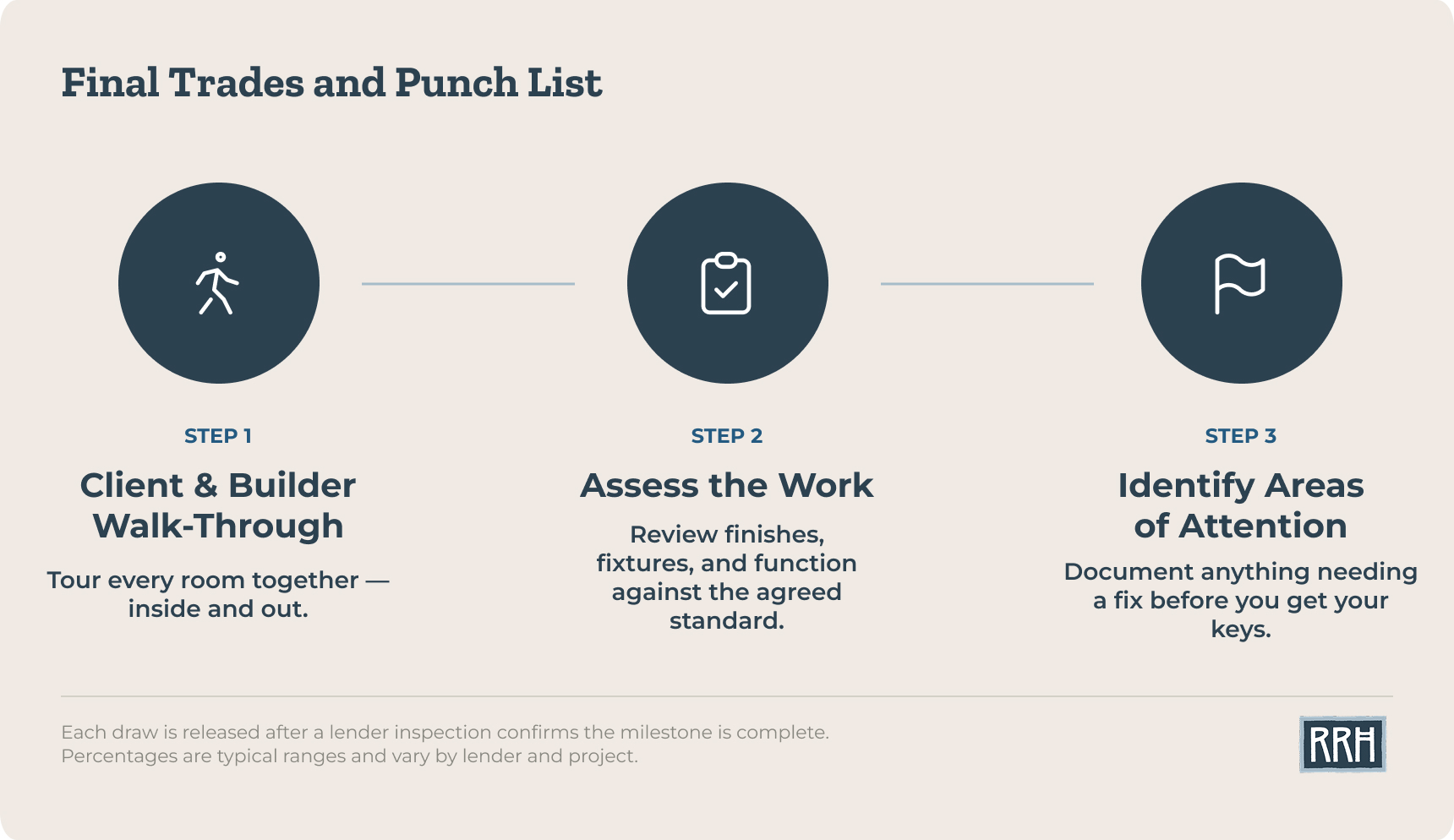
The end is in sight! Fixtures and appliances are installed, trim carpentry wraps up, and final inspections begin — including the Certificate of Occupancy, which is the official green light to move in. The punch list walkthrough happens here: you and your builder walk the home together, document anything that needs attention, and confirm everything meets the agreed standard.
While the punch list is wrapping up inside, the exterior is getting its finishing touches too. Final grading makes sure water drains away from the foundation, the way it’s supposed to. The driveway gets its finish layer – like asphalt, gravel or concrete – and the yard gets seeded for grass.
Seeding is one of those things that’s at the mercy of the calendar. If your build finishes in late fall, seeding may carry into the following spring — that’s completely normal and nothing to worry about. In the meantime, you’ll have fresh gravel in the driveway and a home that’s ready to live in, even if the lawn is still a work in progress. When the time comes, check out this resource for seeding tips in Virginia.
Tips for Avoiding Construction Delays
Every construction project encounters variables, but many common delays can be reduced through planning, communication, and proactive project management. Most delays in new construction come from a short list of predictable causes. Knowing them in advance is half the battle.
- Permitting backlogs in rural counties. Permits must be approved before construction can begin. They help ensure the home meets local requirements and safety standards throughout the building process. Processing times vary by jurisdiction — some counties move quickly, others don’t. RRH’s experience across Central Virginia and into North Carolina means permit applications go in complete and correct the first time, which avoids resubmission delays and permitting backlogs.
- Material lead times. Windows, exterior doors, and cabinets can have lead times of 8–12 weeks or more depending on the manufacturer and current supply chain conditions. Rock River orders early to prevent these items from landing on the critical path.
- Buyer selections not finalized on time. As noted above, this is the most common preventable delay. The earlier selections are locked in, the smoother the finish phase runs. Even small changes can ripple through material orders and subcontractor schedules. That’s not a reason to avoid customizing — it’s just a reason to make decisions early and stick with them once we’re moving.
- Change orders after construction is started. Changes mid-build can affect material orders, subcontractor scheduling, and in some cases permitting — and that affects your timeline and your budget. We’re always happy to talk through changes — just know that the earlier we catch them, the easier it is to keep your timeline on track.
- Subcontractor scheduling in rural markets. Skilled trades are in high demand across Central Virginia. RRH’s long-standing subcontractor relationships and consistent build volume mean crews are scheduled in advance, not sourced from scratch for each job. When you’ve been working with the same crews for years, you’re not starting from scratch every time there’s a scheduling problem — you’ve got a phone number and a track record. We stay ahead of the schedule so one hiccup doesn’t become a two-week delay.
- Weather. Spring rain season and Central Virginia winters can both affect pouring concrete, framing, and site work. RRH factors seasonal conditions into project scheduling to minimize weather-related impact and ensure problems don’t show up later.
Tips To Help Move Your Project Along
Just as some things push a timeline out, others pull it in. Buyers who come to the table prepared consistently have the smoothest builds.
- Have your lot-ready land before signing. If you already have a perc test completed, a survey on file, and basic clearing done, you can skip several weeks of the pre-construction and site prep phases. While Rock River can work with raw land, having your lot build-ready before signing tends to shorten a project by 2 to 4 months.
- Get your financing pre-approved early. Construction loan approval takes time. Buyers who start financing conversations before they finalize a floor plan move faster than those who wait.
- Be decisive in your selections. Buyers who make material and finish choices quickly — and stick with them — keep the build on schedule through the most buyer-dependent phase.
- Select a builder with a reliable local sub network. Rock River’s presence in Amelia, Nottoway, Powhatan and surrounding counties means they’re working with the same trusted crews on repeat. That matters when it comes to scheduling and accountability.
Establishing a Realistic Timeline for Your Project in Central Virginia
For many Rock River homes built on prepared lots, construction can be completed in approximately six months. Homes built on raw land or properties requiring additional site work, utility installation, or permitting may take several months longer.
Every build is different, and the timeline for your specific lot — its location, topography, county, and current condition — will shape the schedule more than any general estimate can. The best way to get a realistic number is to have a direct conversation early.
Also worth reading: Rock River’s How We Work page and First-Time Homeowner: Building vs. Buying for a broader look at what the custom home process looks like from first call to final walkthrough.
Ready to Talk Timelines?
Rock River Homes builds across Central Virginia, from Amelia and Nottoway to Powhatan, Goochland, and beyond. If you want a realistic timeline estimate for your specific lot or floor plan, we’re happy to walk through it with you. Explore our floor plans or reach out at (804) 561-0262.

Become Part of the RRH Family
Explore the ways Rock River can help you find the perfect fit for you and your family.