
The Family Subdivision Loophole: What It Is & How to Use It
Picture this: a father owns 30 acres in Nottoway County. His daughter is renting an apartment in Richmond, paying $1,400 a month, assuming she’ll never be able to afford a home of her own. She has no idea that the land she grew up on — the same land she’s watched her dad pay property taxes on since she was little — could be her way in.
This happens more than you think.
Many states and local jurisdictions have provisions that can make transferring or subdividing family-owned land easier. But crucially, the rules vary significantly from state to state, and a provision that works in one may not exist — or may work very differently — in another.
Virginia law, for example, allows a landowner to subdivide a portion of their property and gift it to an immediate family member, even in counties where standard subdivision is otherwise heavily restricted or banned outright. It’s not a gray area. It’s not a technicality. It’s written directly into the Code of Virginia, and it’s an often underused path to homeownership for working families in rural Virginia.
Because Virginia’s version is particularly well-defined, it’s a useful place to start when learning how family subdivision provisions can work. This post covers what the exemption is, who qualifies, a step-by-step look at how the process works, what the financial upside can look like, and the mistakes to avoid.

A Note Before We Start
This post explains a legal provision in the Code of Virginia in plain language. It is not legal advice. Every situation is different, and the specifics of your county, your land, and your family’s ownership history will affect what’s available to you. An attorney referral is included at several points in this post — those referrals are genuine. When in doubt, consult a Virginia real estate attorney.
What Is the Family Subdivision Exemption?
Most rural Virginia counties restrict subdivision heavily. In many of them, if you want to carve a buildable lot off a larger parcel and sell or transfer it, you’re subject to a full subdivision review process — engineering studies, planning commission approval, road access requirements, and more. In some counties, standard subdivision is effectively off the table for small landowners entirely.
The family subdivision exemption is a specific carve-out that changes that. Under Virginia Code § 15.2-2244, every Virginia county subdivision ordinance must include a provision allowing a single division of a lot or parcel for the purpose of sale or gift to an immediate family member. That’s not optional for counties to include — it’s required by state law.
Here’s what makes it meaningful in practice:
- It applies even in counties where standard subdivision is otherwise banned or heavily restricted. That’s the core reason it matters for rural Virginia families.
- Only one division is allowed per family member. A landowner with three children could potentially use the exemption three times — once for each child — but each recipient only gets one lot.
- Lots under five acres must have a right-of-way of at least 10 feet providing access to a public road. This is a state minimum; the county may require more.
- The division cannot be “for the purpose of circumventing” the local subdivision ordinance. Counties are aware of this and watch for it. A transfer designed to get around the rules, rather than genuinely provide housing for a family member, can be challenged.
“Family land is the down payment for more of our buyers than you’d think. It’s one of those things nobody tells you until you ask the right person.”
— Jack Zilliox, Land Acquisition, Rock River Homes
Read more in our Homebuilder’s Expert Guide.
Who Qualifies as “Immediate Family” Under Virginia Law?
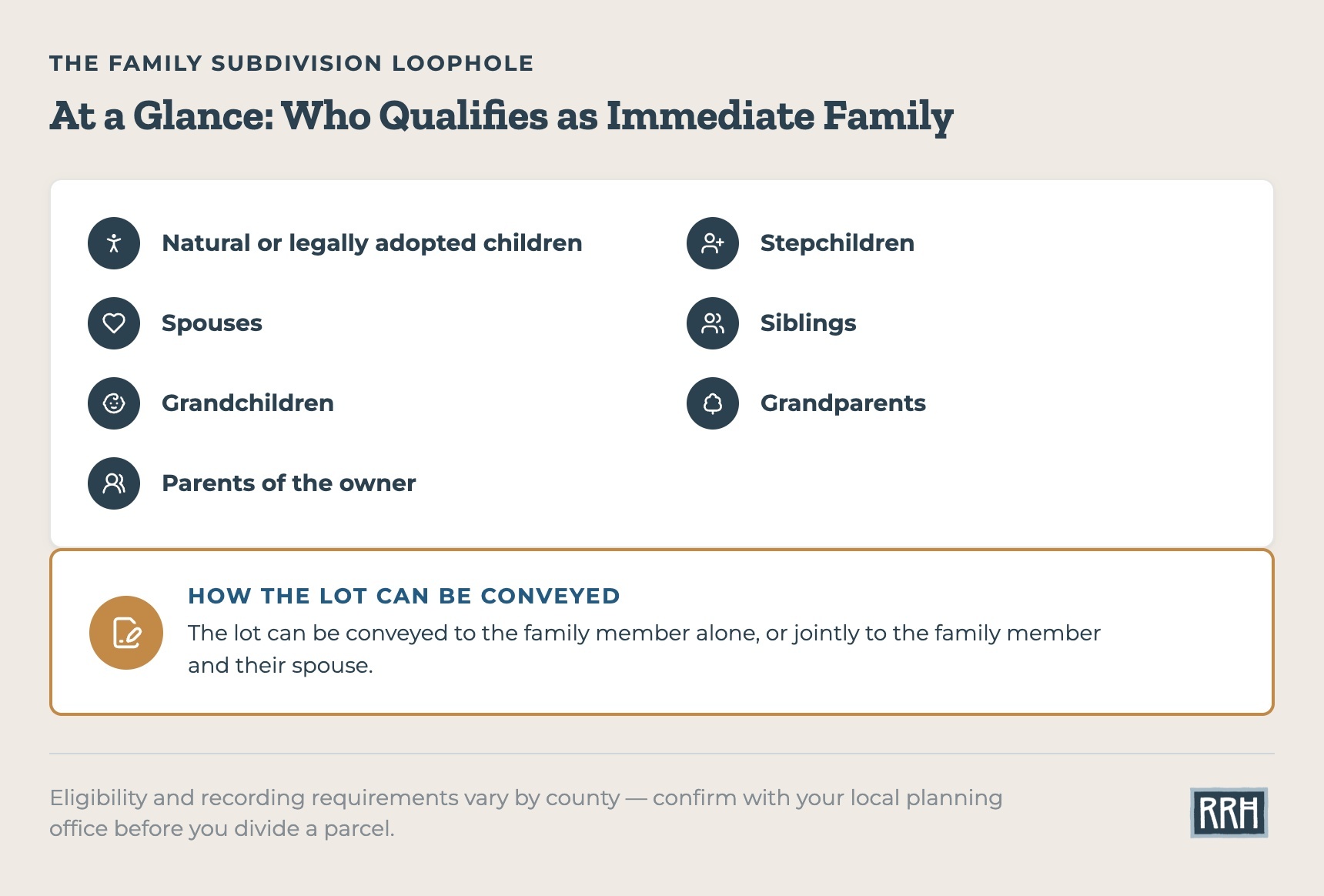
Virginia Code § 15.2-2244 is very specific about its eligibility requirements. Natural or legally adopted children, stepchildren, spouses, siblings, grandchildren, grandparents and Parents of the owner qualify under the state minimum. The lot can be conveyed to the family member alone, or jointly to the family member and their spouse.
Some Virginia counties optionally expand this definition to include aunts, uncles, nieces, and nephews. That’s a county-level decision, not a state requirement. Contact the local planning department to confirm what applies in your county.
When to Get an Attorney Involved
Step-relationships, adoptions, and trust situations can raise eligibility questions that aren’t always clear from the statute alone. If your situation involves any of these, consult a Virginia real estate attorney before proceeding. Getting a clear answer early is much cheaper than discovering a problem after the deed is recorded.
Has the Land Been in the Family for 15 Years? Here’s a Second Path
Virginia provides a second, separate legal path for family subdivisions under § 15.2-2244.1. This one has a longer ownership requirement and a significant resale restriction — but it matters in situations where the first path isn’t available.
Under this provision, a locality may allow an additional family subdivision if:
- The property has been owned for at least 15 consecutive years by the current owner or a family member, and
- The owner agrees to place a restrictive covenant in the deed prohibiting transfer to a non-family member for 15 years after the subdivision
The locality may also require the subdivided lot to be no more than one acre under this provision — a meaningful constraint compared to the first path.
The 15-year resale restriction is the most important thing to understand here. It is recorded in the deed and runs with the land. If the recipient later wants to sell, even if their circumstances change significantly, they can only sell to another immediate family member for 15 years, unless the county modifies the covenant. That’s a real limitation on a major financial asset, and anyone considering this path should understand it fully before proceeding.
This path is most useful when the primary § 15.2-2244 exemption has already been used for this family member, or when a county has structured its ordinance to require the longer-ownership provision.
Here’s a side by side comparison of the two paths:

What About Land Held in a Trust?
Property held in a trust is addressed under a separate provision, § 15.2-2244.2. For a trust to qualify, all trust beneficiaries must be immediate family members and must agree to the subdivision and the 15-year resale restriction. This is a situation where working with a Virginia real estate attorney isn’t just recommended — it’s essentially required to get it right.
The Financial Upside: How This Unlocks a Path to Zero-Down Homeownership
This is the part most renters sitting on family land have never heard — and it’s the reason this exemption matters so much for working families in rural Virginia.
When a parent gifts a parcel of land to their child, that land immediately becomes equity. No money changes hands, but the child now has an asset — and that asset has real value that lenders recognize. In most cases, land equity counts as the down payment on a construction loan. That means a renter who assumed homeownership was years away might be able to build without a single dollar of cash down payment.

Rock River works closely with Alcova Mortgage, who specialize in rural Virginia new construction financing and know how to structure construction loans around land equity. We’re happy to make that introduction. For a deeper look at how construction loan financing works in practice, read our Construction Loans Explained post.
Step-by-Step: How the Family Subdivision Process Works

Step 1 — Verify Eligibility Before Anything Else
Before anything else happens, confirm the following:
- The property is in a Virginia county. Virginia cities have their own subdivision ordinances and may not follow the same rules.
- The parcel is zoned to allow residential construction. Agricultural zoning in some counties requires a rezoning or special use permit before a home can be built.
- The family subdivision exemption hasn’t already been used for this specific family member. Each recipient can only receive one subdivision under this provision.
- Contact the county planning department to confirm the process, timeline, and any county-specific requirements.
Pro Tip: Make the Call First
A five-minute call to the county planning department tells you whether this path is available for your specific parcel, what the local process looks like, and how long it typically takes. This call costs nothing and can save months of effort on a path that doesn’t apply to your situation.
Step 2 — Get a Survey
A licensed land surveyor must prepare a plat showing the proposed subdivision — resulting parcels, boundaries, acreage, and access to a public road. This plat is what gets submitted to the county for approval. It cannot be skipped or approximated.
Surveying costs vary by county, parcel complexity, and surveyor. Get multiple quotes. In rural Central Virginia, expect costs to range from a few hundred dollars for a straightforward parcel to several thousand for complex terrain or unclear property lines.
Step 3 — Submit to the County Planning Department
Submit the plat and application to the county. Requirements vary significantly. Some counties handle family subdivision as an administrative review — a staff-level decision with no public hearing. Others require planning commission approval, which takes longer and involves more steps.
In counties where Rock River builds most actively, the process looks like this:
| County | Notes and Contact |
|---|---|
| Mecklenburg County | Updated ordinance late 2025 — new plat review procedures. Contact planning dept. directly for current requirements. |
| Nottoway County | Accepts standard IRC/USBC codes; active residential construction. Call: 434-292-3438. |
| Brunswick County | Standard zoning: one dwelling per lot. Special situations handled by planning dept. |
| Dinwiddie County | Defined subdivision ordinance with specific process requirements. Contact planning dept. |
| Prince Edward, Amelia, Cumberland, Buckingham, Surry, Sussex | All within Rock River’s active footprint. Each county administers differently. RRH experience across these counties is a practical advantage. |
Attorney Referral
If the subdivision involves a trust, an estate, or any ownership complexity — multiple names on the deed, inherited land with unclear title, a recently deceased owner — consult a Virginia real estate attorney before submitting to the county. Errors at this stage can delay or derail the process.
Step 4 — Record the Deed
Once the plat is approved, the transfer is documented in a deed conveying the subdivided parcel from the landowner to the family member. Under Virginia Code § 55.1-300, the deed must identify the parties, describe the property, state the consideration, and be signed and notarized.
For a gift — which is the most common scenario here — the consideration is typically nominal: “for love and affection and $1” is standard language.

If a restrictive covenant is required under § 15.2-2244.1, it must be included in the deed or recorded as a separate instrument at the same time.
The deed is recorded in the circuit court clerk’s office in the county where the land is located. A recording fee applies.
Step 5 — Perc Test and Site Evaluation
A legally transferred lot is not automatically a buildable lot. Before any building permit can be issued in most Virginia counties, the soil must pass a percolation (perc) test, which determines whether it can support a septic system.
If the perc test fails, a conventional septic system won’t work. Alternative systems — mound systems, drip irrigation systems — may still be viable, but they cost more. In some cases, the soil simply can’t support any system. That’s a hard stop on construction.
The perc test should happen before the land is transferred if at all possible. Build it into the process as an early step, not an afterthought. For a full picture of what site preparation involves and what it costs, read our Hidden Costs of Buying Land in Virginia post.
Rock River conducts site visits to evaluate foundation placement, clearing, driveway routing, electrical access, and septic suitability before any contract is signed. You don’t get estimates based on county averages — you get a picture based on the actual land.
Pro Tip: Perc Before the Transfer
If possible, run the perc test before the subdivision is finalized. A lot that fails the perc test after it’s been transferred — and after surveying and recording fees have been paid — is a much more expensive problem than one discovered during due diligence. Make it part of the process, not the end of it.
Step 6 — Site Prep and Build
Once the lot is legally established and the perc test is complete, the build process begins: clearing, grading, well, septic system installation, driveway, electrical hookup, and construction. For a full walkthrough of what this looks like phase by phase, read our How Building a Home on Land Actually Works post.

- Buying the land before verifying eligibility. The exemption doesn’t apply to every parcel. Confirm it works for your specific lot before any money changes hands.
- Skipping the perc test. A transferred lot isn’t automatically buildable. The perc test has to happen before septic approval — and before you can pull a building permit.
- Missing the 15-year resale restriction. If § 15.2-2244.1 applies, that restriction is recorded in the deed and follows the land. The recipient needs to understand it before signing anything.
- Skipping the licensed surveyor. The county requires a proper plat. There’s no workaround for this one.
- Using the exemption to get around subdivision rules. § 15.2-2244 explicitly prohibits this, and counties watch for it. The transfer has to be genuine.
Common Questions About the Family Subdivision Exemption
Can I use this exemption more than once?
A landowner can use the exemption once per immediate family member. If you have three children and want to subdivide a lot for each of them, that’s three separate uses of the exemption — one per recipient. But each recipient can only receive one subdivided lot from one landowner under this provision.
Does the land have to be gifted or can it be sold?
Virginia Code § 15.2-2244 allows a division “for the purpose of sale or gift” to a family member — so yes, the parcel can be sold to the family member at fair market value rather than gifted. That said, the gift scenario is far more common in practice, and the financial upside described above depends on the land being gifted rather than purchased.
What if the land is held in a trust?
Land held in trust is governed by § 15.2-2244.2. All trust beneficiaries must be immediate family members, and all must agree to the subdivision and the 15-year resale restriction. This is a situation that almost always benefits from working with a Virginia real estate attorney before proceeding.
Do I need an attorney?
Not always required, but strongly recommended for deed preparation, trust situations, estate complications, and any ownership history that isn’t completely straightforward. The exemption itself is accessible, but the execution — particularly the deed — has enough room for error that professional help is usually worth the cost.
Can I build immediately after the deed is recorded?
Not quite. Recording the deed establishes legal ownership of the subdivided parcel, but a building permit still requires perc test approval, a site plan, and county review. In most counties that process runs several weeks to a few months depending on workload. Plan for that time — it runs in parallel with financing conversations and floor plan selection, so it doesn’t necessarily add to the overall timeline if you’re managing the process proactively.
What if the perc test fails?
A failed perc test doesn’t automatically mean the land is unbuildable, but it does mean a conventional septic system won’t work. Alternative engineered systems may still be viable at higher cost. In some cases, a soil scientist can identify suitable areas that a standard test missed. And in some cases, the land genuinely can’t support any system. That’s why the perc test belongs as early in the process as possible — ideally before the subdivision is finalized.
How Family Subdivision Laws Apply in Other States
Virginia isn’t the only state where families can use special provisions to create a homesite for an immediate family member. North Carolina, Tennessee, Kentucky, West Virginia, Georgia, and other Southern states have similar laws or local provisions, but how they work varies. Some are established at the state level, while others leave more discretion to local governments. Requirements for eligible family members, lot sizes, resale restrictions, and frequency of use can also differ.
For example, North Carolina’s G.S. 153A-335 provides a specific exemption for certain divisions made for immediate family members, creating an option similar in concept to Virginia’s § 15.2-2244.
The takeaway for landowners is simple: if you’re considering creating a homesite for a family member, it’s worth checking whether your state and county offer a similar provision.
How Rock River Homes Helps Land Inheritors
The family subdivision exemption is one of those provisions that makes a real difference for working families in rural Virginia, if they know it exists. Most don’t. And even among those who do, the connection between gifted land, land equity, and zero-down construction financing isn’t always obvious.

What we’ve found over two decades of building in Central Virginia is that the families who move fastest are the ones who start the conversation early — before the land is transferred, before the financing is sorted, before any commitments are made. That early conversation is where we can do the most to help: evaluating the specific parcel, walking through what a build would cost, connecting buyers with lenders who understand rural new construction financing, and giving a clear picture of what the path actually looks like.
If you or a family member owns land in rural Virginia and you’ve ever wondered whether it could be a path to building a home, that conversation is worth having. It doesn’t cost anything, and it might change what you think is possible.
Call us at (804) 561-0262 or reach out through our contact page.
Want to Explore Your Options?
Rock River Homes builds across approximately 48 Virginia counties and into North Carolina. If your family owns land in Central Virginia and you want to understand what it would take to build on it — including whether the family subdivision exemption applies — reach out at (804) 561-0262. We’ll give you a straight answer about what’s realistic for your specific parcel.


Become Part of the RRH Family
Explore the ways Rock River can help you find the perfect fit for you and your family.