
Commute vs. Space: Is a Longer Drive Worth More Land?
If you’ve ever sat in traffic on I-64 or I-95, you’ve probably done the math in your head: what if I just moved further out? More land, more space, lower cost — and a longer drive. It’s one of the most common trade-offs in housing, and there’s no universal right answer. So we’ve pulled together a few tools so that you don’t have to rely purely on gut instinct.
This post lays out an honest case for both sides, and we’ll use Virginia as an example. The first half applies to buyers and renters anywhere in the country who are weighing location against space. The second half gets specific: if you’re in Virginia, here’s what the data and map actually look like, and which areas offer the most favorable trade-offs right now.

Why This Trade-Off Matters More Than It Used To
This isn’t a new question, but the stakes are higher than they’ve ever been. In most major metro areas, housing costs have climbed far faster than incomes. And whether you’re a first time or seasoned buyer, the result is the same: the homes you can afford are increasingly not where you want to live.
At the same time, remote and hybrid work have fundamentally changed what ‘commute burden’ actually means. A buyer who commutes five days a week and one who commutes two days are making very different calculations — even if they’re looking at the same house on the same lot.
The result is that location vs. space is no longer just a lifestyle question. For millions of households, it’s a recurring financial trade-off with real numbers attached. And for the first time in decades, the math is increasingly favoring space over proximity.
What the Data Shows
Since 2020, rural counties and small towns have become the top destination for people moving within the U.S. Two-thirds of growth in the 25–44 age group has occurred in smaller metros or rural counties — a dramatic reversal from the prior decade, when 90% of that growth was concentrated in the largest metro areas. The driving forces: high housing costs in major cities, and the rise of remote work. (Source: Weldon Cooper Center for Public Service, University of Virginia)
The Key Factors That Shape This Decision
Most people approach this trade-off as a single equation: is the commute worth the savings? But in practice, it usually comes down to three overlapping factors, and the right answer depends on how they interact for your specific situation.
- Lifestyle priorities: space, privacy, land use, pace of life — and increasingly, whether the home supports remote or hybrid work. A dedicated office, reliable high-speed internet, and enough separation between work and living space are practical considerations that belong in this column, not just nice-to-haves.
- Financial reality: what you can afford, and how total monthly costs compare across locations once commuting is factored in
- Access and commute constraints: where your job is, how often you actually need to be there, and how much time that drive takes in practice — including everyday errands like groceries, healthcare, and other services that also shift further away when you move rural.”
Change any one of these and the answer shifts. A hybrid worker with two office days a week is solving a different problem than someone who commutes five days. A buyer who wants a workshop and room for animals has different priorities than one who wants a smaller yard and a shorter drive to restaurants. The framework matters more than any blanket answer.
What More Space Changes in Practice
Moving further out doesn’t just mean a bigger yard. The benefits compound in ways that aren’t always obvious upfront.
| What More Space Gives You | What a Longer Commute Costs You |
|---|---|
| More space & land | Longer commute time |
| Lower housing density | Higher vehicle costs |
| More privacy | Less daily convenience |
| Land use flexibility | Further from services |
| New construction options | Reduced scheduling flexibility |
| Lower cost per sq ft | |
| Room for kids, animals, expansion | |
Cost per square foot typically drops significantly as you move away from major metros — meaning the same monthly payment often buys substantially more home and land. New construction becomes more accessible in rural areas, where land costs don’t inflate the total price the way they do closer to the city. Property taxes in many rural Virginia counties are meaningfully lower than in suburban areas, though rates vary enough that it’s worth checking county by county.
The less tangible benefits are real too. Privacy, quiet, and the ability to actually use your land — whether for a garden, a shop, animals, or just space for kids to run — are hard to put a number on but easy to undervalue when you’re making a spreadsheet-based decision.
What Commuting Actually Costs You
The commute cost is almost always underestimated, and almost always calculated wrong. Most people think in miles. The more useful unit is time and money per week.
- Time: a 45-minute commute each way is seven and a half hours per week if you’re going five days. At two days, it’s three hours. At zero days, it’s nothing. The frequency of your commute changes this calculation more than the distance does.
- Vehicle costs: The IRS standard mileage rate (currently 76 cents per mile as of 2026) accounts for fuel, maintenance, and depreciation. An additional 30 miles each way, driven 5 days a week, adds nearly $1,000 per month in vehicle operating costs before you account for the value of your time.
- Access trade-offs: rural living typically means more distance to groceries, healthcare, restaurants, and services. For some households, that’s a minor inconvenience. For others, it’s a daily friction that adds up.
- Scheduling flexibility: when everything requires a 30-minute drive, spontaneity costs more. That’s not a dealbreaker, but it’s real.
Quick Math: The Commute Cost Formula
Use this simple formula:
Additional miles each way × 2 (round trip) × IRS mileage rate × commute days per week × 52 weeks ÷ 12 = estimated monthly vehicle cost
- Example 1 (Hybrid): An additional 30 miles each way, commuting 3 days per week at $0.76/mile:
30 × 2 × $0.76 × 3 × 52 ÷ 12 = about $593/month - Example 2 (Full-time): The same commute 5 days per week:
30 × 2 × $0.76 × 5 × 52 ÷ 12 = about $988/month
Compare this number to your monthly housing savings to understand the true financial trade-off.
How to Run the Numbers for Your Situation
The decision to trade commute time for space is worth running as an actual financial comparison, not just a feeling. Here’s how to frame it.
- Start with the housing savings: what is the difference in monthly mortgage payment between the closer-in option and the further-out option? Include property taxes and any HOA fees in that comparison, since those can vary significantly.
- Subtract the additional commute cost using the formula above. What’s left is your net monthly savings from moving further out — before any lifestyle value is assigned to the additional space.
- Then factor in the variables that change based on your work situation:
- 0 commute days (fully remote): the commute cost is near zero. The financial case for space is at its strongest.
- 2 commute days (hybrid): commute costs are manageable for most buyers. Space likely wins if the housing savings are meaningful.
- 5 commute days (fully in-office): the commute cost is highest and the time cost is real. The math is closer, and personal preference matters more.
One factor that changes the equation significantly for rural land: site costs. If the property needs a well, septic system, clearing, or utility hookups, those are upfront costs that should be factored into the comparison alongside the purchase price. Talking with a builder or local expert early — before making an offer — is the most reliable way to pressure-test total cost on a rural parcel.
Why Buyers Are Trading Commutes for More Space
Everything above applies broadly to housing decisions anywhere in the country. But in our Virginia example, the picture has shifted in ways worth understanding.
Virginia’s major employment centers — Richmond, Charlottesville, and Northern Virginia — have become increasingly expensive relative to the rural areas surrounding them. Buyers can often find substantially more land and newer homes within a reasonable drive of all three, at prices that would be unimaginable inside the city limits.
Remote and hybrid work have expanded the range of locations many Virginia households can realistically consider.
What the Data Actually Shows
The numbers back it up. According to researchers at the Weldon Cooper Center for Public Service at the University of Virginia, young adults have increasingly moved to or remained in Virginia’s smaller metro areas and rural counties — and left or not moved to Northern Virginia and Hampton Roads. The trend accelerated during the pandemic and, notably, has not reversed. In 2024, the number of people moving to parts of Virginia outside its three largest metro areas was higher than in 2022, which was itself twice the number seen in 2019.
Virginia by the Numbers
Of Virginia’s 133 cities and counties, 46 are now growing younger — and virtually all of them are outside the urban crescent. Louisa County is among them. The common thread: housing affordability and remote work flexibility are allowing younger buyers to make location decisions that would have been professionally risky just a decade ago. (Sources: Weldon Cooper Center for Public Service, UVA; Cardinal News, September 2025)
Central Virginia’s housing market reflects this shift directly. Demand in exurban and rural counties has risen, and in some areas, inventory hasn’t kept up. For buyers actively considering this trade-off, the window of relative affordability in these areas may not stay open indefinitely.
Which Virginia Areas Offer the Best Trade-Off
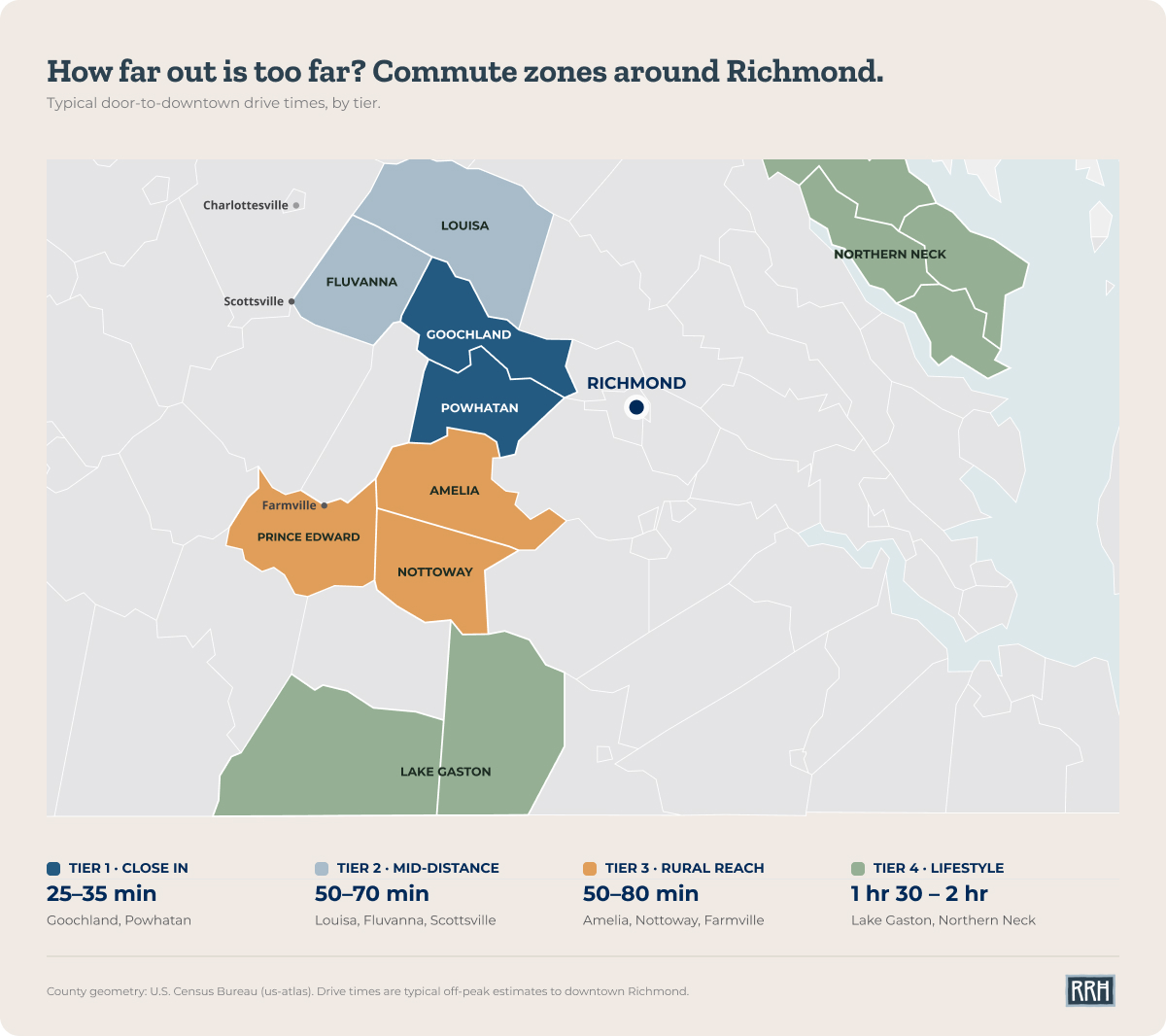
The right balance depends on where you work, how often you commute, and what you want from the property. Here’s a practical breakdown of the Central Virginia options, moving from closest-in to furthest out.
| Area | Approx. Commute | Best For |
|---|---|---|
| Goochland / Powhatan | 20–35 min from Richmond | Shortest commute, more space than metro, popular with city escapees |
| Louisa / Fluvanna / Scottsville | 35–50 min from Richmond & Charlottesville | Middle ground: larger lots, strong affordability, easy access to major employers |
| Farmville / Amelia / Nottoway | 45–60+ min from Richmond | Maximum land per dollar; best for remote workers or those with flexible schedules |
| Lake Gaston / Southside Virginia | Lifestyle-first destination | Waterfront and recreation; less centered on daily commuting |
| Northern Neck | Lifestyle-first destination | Coastal and riverfront; privacy and land over proximity to metros |
We build across all of these areas and know them because we live and work in them — not because we’ve studied them from a distance. That said, we’re builders, not estate guides. The best way to get a ground-level read on any specific parcel is to start a conversation early, before you’ve made an offer, so the site evaluation can inform your decision rather than complicate it.
Bottom Line: How to Make the Call
At its core, this is a trade between time density and land density. You can have more of one, but usually not both.
Space wins when:
- Total monthly savings from lower housing costs exceed your additional commute cost
- You work remotely or have a hybrid schedule with limited commute days
- The lifestyle value of land, privacy, and space matters more than proximity to daily conveniences
- You’re planning to build new, which gives you more options in rural areas than in competitive suburban markets
Closer-in housing wins when:
- You commute five days a week and the time cost is genuinely significant
- Daily access to services, healthcare, schools, or restaurants is a priority
- Your schedule requires flexibility that a 45-minute drive would routinely complicate
There’s no wrong answer. There’s just an honest accounting of what each choice actually costs — in money, in time, and in the way you want to live. Run the numbers, know your commute frequency, and don’t make the decision based on best-case assumptions on either side.
Want to Run the Numbers on a Specific Area?
Rock River Homes builds across approximately 48 Virginia counties — from Goochland and Powhatan to Amelia, Nottoway, Louisa, Fluvanna, the Northern Neck, and Lake Gaston. If you’re weighing commute vs. space and want a real conversation about what land and build costs look like in a specific county, call us at (804) 561-0262 or reach out through our contact page.


Become Part of the RRH Family
Explore the ways Rock River can help you find the perfect fit for you and your family.